
Te Uru o Tāne, formerly Daleton Nursery, is Greater Wellington’s new facility to meet the region’s growing demand for erosion control and riparian management trees. These trees, such as poplars and willows, play a critical role in stabilising soil and protecting waterways across the region.
Why is this project important?
Erosion control is vital for sustainable land management, especially in areas prone to soil loss. In 2018, a review identified the need for a new nursery that could operate year-round, particularly during dry periods when water resources are scarce. Te Uru o Tāne addresses this need and helps ensure a consistent supply of trees, supporting production at Akura Nursery.
Te Uru o Tāne helps to provide employment opportunities for the local community. Operating two complementary nursery sites in Wairarapa reduces production risks and provides greater resilience of supply.
How does Te Uru o Tāne work?
A unique aspect of Te Uru o Tāne is its use of treated wastewater from Carterton's municipal wastewater system for irrigation. This reduces environmental impact by limiting the discharge of treated wastewater to waterways, and ensures a sustainable water supply for the nursery.
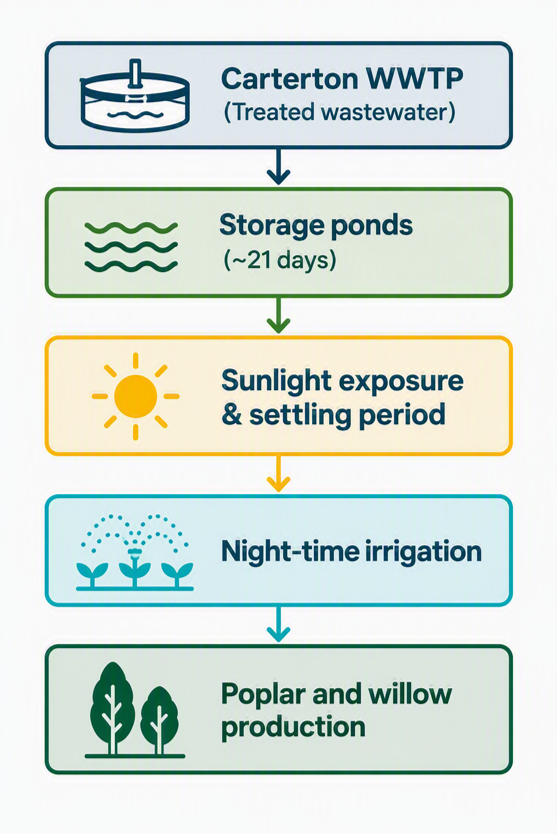 The nursery is located on 28 hectares of land beside the wastewater treatment plant. The treated wastewater is held in storage ponds for around 21 days. During this time, natural processes including sunlight exposure reduce some microorganisms, providing an additional layer of treatment.
Irrigation takes place mainly at night and over an area of approximately 20 hectares using a “smart” sprinkler irrigation system. Night-time irrigation reduces evaporation losses.
The health and safety of the staff and community are the top priority. Measures are in place to manage all the risks associated with using treated wastewater.
Environmental monitoring includes:
- Soil testing – testing for contaminants, and nutrients in the soil
- Herbage testing – testing for the nutrients present in the plants’ leaves
- Plant growth monitoring – comparing plant growth to Akura Nursery.
Carterton District Council also conducts monthly testing of their treated wastewater, and an annual test for the presence of viral pathogens and heavy metals.
Continuous monitoring has shown the use of recycled treated wastewater at Te Uru o Tāne is safe and sustainable for the land and trees.
The nursery is the first of its kind, so the health and quality of the plants grown there will continue to be monitored to ensure their efficacy for soil protection and erosion control.
Who's involved?
Te Uru o Tāne is a collaborative project between Greater Wellington, Carterton District Council, and Ngāti Kahukuraāwhitia. Together, we have worked to develop the nursery, ensuring it aligns with both environmental goals and local community interests. The partnership also provides employment opportunities for the local community, including hapū members, making it a project that supports both the whenua and the people.
What’s next for Te Uru o Tāne?
The first poplars and willows were planted in 2024, marking a key milestone.
The innovative and sustainable poplar and willow pole nursery on the outskirts of Carterton will reach its first harvest in winter 2027. This marks the culmination of investment and planning to improve the resilience of regional poplar and willow supply to stabilise soil and protect waterways in the region.
The meaning behind the name
In 2025 the nursery was gifted the name Te Uru o Tāne by Ngāti Kahukuraāwhitia. It refers to a traditional kāinga (habitat) located between Greytown and Carterton, and means “the grove of the trees of Tāne-mahuta”, a reference to the sheer number of rākau (trees) that once covered the whenua. The name speaks to both the history of the land and the nursery’s purpose: restoring and strengthening our region’s natural landscapes through planting.

Get in touch
- Phone:
- 0800 496 734
- Email:
- info@gw.govt.nz